
Mole Control Albany, Ny -
Removal & Extermination
Moles can create unsightly tunnels and damage lawns, gardens, and landscaping. Our Mole Control Service in Albany, NY offers effective solutions to locate active mole activity, eliminate the problem, and help prevent future infestations. We provide reliable, customized mole control services for residential and commercial properties throughout Albany, helping keep your yard healthy and protected.
Mole Extermination and Yard Pest Control for Albany Homeowners
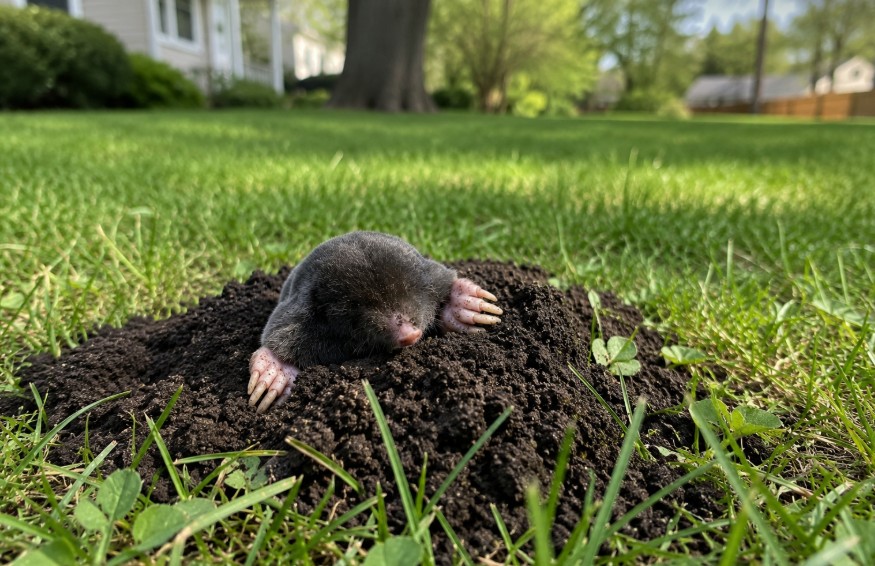
Raised ridges snaking across your lawn near Buckingham Lake or a cone-shaped mound popping up overnight in the Helderberg neighborhood usually means one thing: a mole has moved into the yard. Unlike gophers, moles aren't after your plants — they're tunneling in search of earthworms and grubs, which makes them a different kind of pest control problem with a different fix. We provide mole removal and extermination across Albany, working lawns on both sides of the city's old lakebed, from the moisture-retentive clay soil near the Hudson to the looser, sandier ground out toward the Pine Bush.
If your yard has ridges, soft spots, or sudden mounds and you're not sure what's causing them, we'll find out and handle it.
Where Moles Nest (and Why It Matters for Treatment)
Most homeowners picture a mole living right under the mound it just pushed up — but that's not where the action is. Moles build their actual nest much deeper, typically 12 to 18 inches down, in a small chamber lined with dried grass and leaves. That nest connects to a network of deep tunnels used for travel, and a separate web of shallow surface tunnels — the raised ridges you see in the lawn — used almost exclusively for hunting earthworms near the surface.
This matters for Albany properties specifically. Our winter frost line regularly reaches 32 to 48 inches down, deep enough that a mole only has to drop a foot or two below its nest to stay below the freeze and keep hunting all winter, since moles don't hibernate. That's also roughly the same depth our local building code requires for footings — so in a strange way, the frost line that protects your foundation is the same line a mole is using as its winter floor. It's also why mole activity in Albany yards rarely fully disappears in colder months; it just moves deeper and gets harder to spot until ridges reappear with the spring thaw.
Signs You Have a Mole Problem, Not Something Else
-
Volcano-shaped mounds with the entrance hole at the center — different from a gopher's fan-shaped mound with an off-center plug.
-
Raised ridges zigzagging across the lawn, often appearing after a rain when soil is soft and easy to push through.
-
Soft, spongy turf that gives way underfoot along a tunnel line.
-
Surface tunnels along hard edges — driveways, sidewalks, foundation lines, and garden borders, since moles often route deep tunnels along these man-made boundaries.
-
No actual plant damage — root vegetables and flower beds are usually intact, since moles eat insects, not vegetation (if you're seeing chewed bulbs or vegetables, you may be dealing with voles using the mole's tunnels, not the mole itself).
What's Included in Our Albany Mole Control Service
We trace active deep-tunnel routes versus old abandoned surface tunnels, and check moisture levels and earthworm activity, since a wet lawn with a healthy earthworm population is exactly what draws moles in and keeps them around.
Scissor and harpoon-style traps are set directly on confirmed active tunnel sections, not on mounds, which are simply waste piles and not where the mole travels.
We check trap placement and flatten test sections of tunnel to confirm which paths are still in daily use before finalizing removal.
We talk through watering habits and grub control, since over-watered lawns and heavy grub populations are often what brought the mole in to begin with.
Methods & Tools for Mole Control and Removal
- Tunnel mapping — flattening sections of surface tunnel to identify which paths are actively reused day to day
- Scissor and harpoon trapping — the most reliable removal method, placed on long, straight stretches of deep tunnel
- Grub and earthworm management — reducing the underlying food source that sustains mole activity in turf
- Watering adjustments — drier soil is less hospitable to the earthworms moles hunt, making a yard less attractive over time
- Exclusion barriers — buried mesh around garden beds to keep tunnels from cutting through high-value planting areas
- Vibration and repellent devices — used selectively as a deterrent in combination with trapping, not as a standalone fix
Cost of Mole Removal in Albany
Mole removal pricing depends mainly on how many active tunnel systems are present and how large the property is — a single tunnel line along a driveway is a smaller job than a yard with multiple ridges crossing several garden beds. We provide a free estimate after inspecting the property and mapping active tunnels, so the quote reflects what's actually happening underground rather than a flat rate based on lawn size alone.
Why Choose Our Albany Rodent Control Team
We know the difference between a mole problem and a gopher problem, and our rodent experts treat them differently — using mole-specific trap placement instead of a generic approach that doesn't account for how moles actually move through a yard. Albany's mix of clay-heavy soil downtown and sandier, well-drained ground near the Pine Bush also means mole pressure varies block to block, and we adjust our inspection accordingly rather than running the same playbook on every property.
-
24/7 availability for active infestations
-
Free estimates before any work begins
-
A service guarantee on completed removal work
Serving Albany Neighborhoods and Surrounding Areas
We handle mole removal and pest control throughout Albany, including:
Buckingham Lake, Helderberg, Pine Hills, Center Square, Washington Park area, Delaware Avenue, New Scotland Avenue corridor, Whitehall, and Krumkill.
We also serve nearby communities including:
Delmar, Guilderland, Colonie, Slingerlands, Loudonville, Latham, and Rensselaer.
Don't see your neighborhood listed? Get in touch — we likely cover your area.
FAQs
How do I know if it's a mole and not a gopher tunneling in my yard?
Mound shape is the giveaway. Mole mounds are cone-shaped with the opening at the center; gopher mounds are fan-shaped with a plug off to one side. Moles also leave plants untouched since they're hunting insects, while gophers will chew through roots and vegetable gardens directly.
Why does my lawn have mole ridges right along the driveway and sidewalk?
Moles frequently route their deep, main travel tunnels along hard borders like driveways, foundations, and sidewalks because these edges give the tunnel a stable, defined boundary to dig against. If you're seeing repeated activity in the same strip along a hardscape edge, that's likely a primary tunnel, not a one-off feeding path.
Do moles disappear in the winter, or are they still active under my Albany lawn?
They're still active. Moles don't hibernate — they simply move into deeper tunnels below the frost line, which in our area can run 32 to 48 inches down, and continue hunting through the colder months. Surface activity slows because the ground is frozen, but the mole hasn't left.
Will killing the grubs in my lawn get rid of the mole problem?
It can help reduce what's attracting moles in the first place, since grubs and earthworms are their primary food source, but grub treatment alone usually isn't enough to remove an established tunnel system. Trapping the active tunnels directly is still the most reliable way to fully resolve an existing mole problem, with grub management as a longer-term prevention step.