
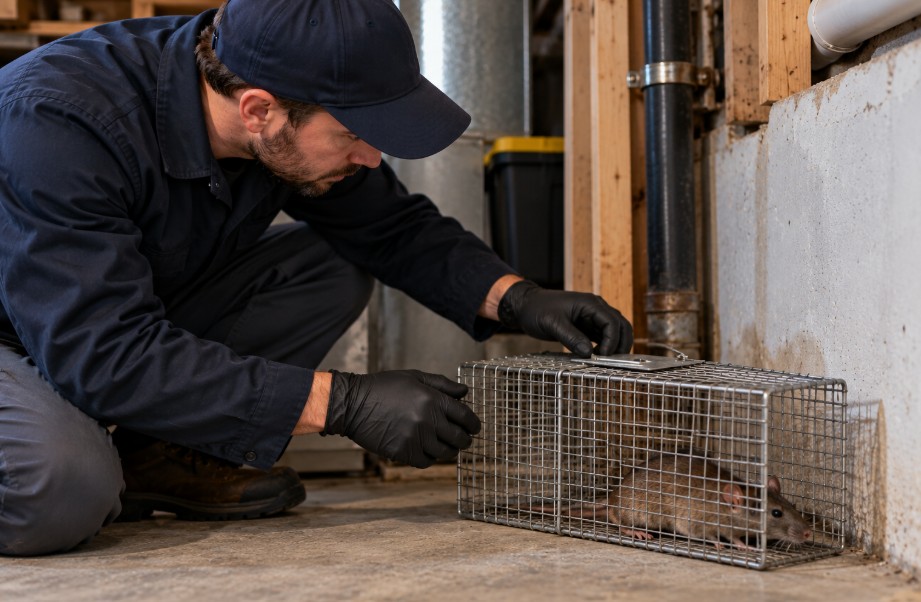
Rodent Trapping in Albany, NY
Mice in the kitchen, rats in the cellar, something in the wall at night. We put the right traps on the routes rodents already use, check them on schedule and take away everything we catch, until the traps stay empty.
Types of Rodents We Trap
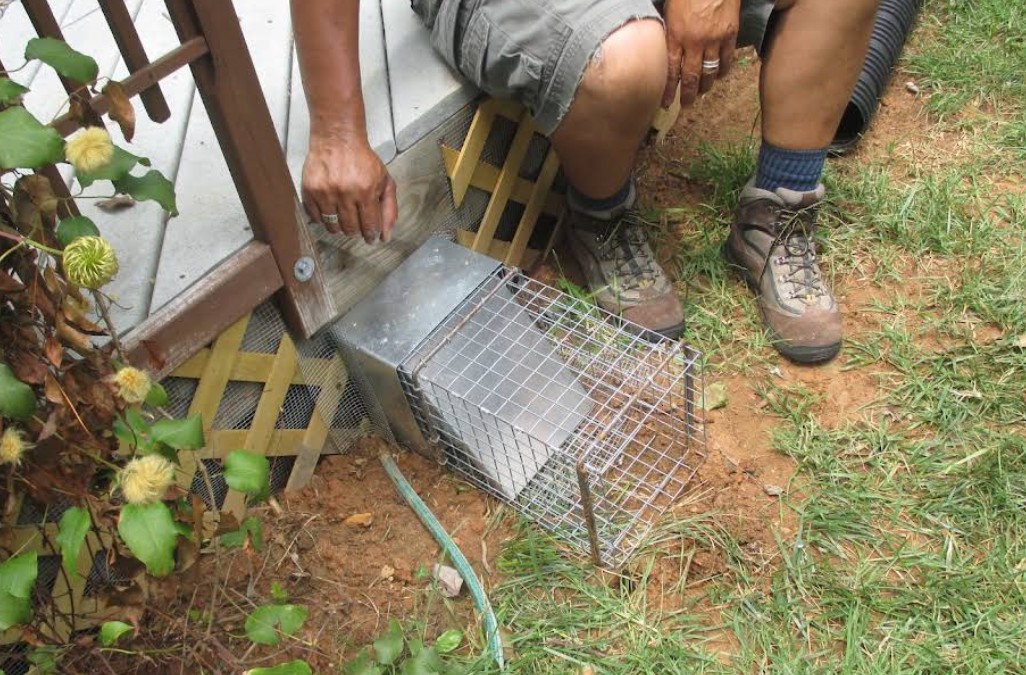
The animal decides the trap. A mousetrap does not have the force to kill a rat, and a rat trap is often too slow for a mouse. A trap that suits neither is why a lot of home trapping stalls.
| Rodent | Where we find it in Albany | How we trap it | What makes it tricky |
|---|---|---|---|
| House mouse | Kitchens, wall cavities and cellars citywide, all year | Mouse-size snap traps set close together along walls, behind appliances and at pipe holes | Mice stay close to the nest and learn to avoid traps left in one spot too long |
| Norway rat | Cellars, foundations and yards, most often downtown, the South End, near the Port and around restaurants | Rat-size snap traps, baited but left unset until the rats feed from them with confidence, then set | Rats distrust anything new. Rush the first step and they become very hard to catch |
| White-footed mouse and deer mouse | Attics, garages and crawl spaces on wooded edges: New Scotland, Buckingham Lake, the Pine Bush, Delmar, Guilderland | Snap traps at the roofline, eaves and garage, with exterior sealing as the real fix | They come in from outside every fall, so trapping indoors alone repeats each October |
| Gray squirrel | Attics and soffits under mature street trees | A one-way door over the entry hole, backed up with cage traps | A protected species in New York, and young may be in the nest in late winter and midsummer |
| Flying squirrel | Attics near woods, usually in groups through the winter | One-way doors over small roofline gaps | Several animals use several openings, and all of them have to be found |
A note on roof rats: they are listed on many pest control sites, but they are not established in upstate New York. A rat in an Albany attic is a Norway rat that climbed.
Why We Trap First
Poison looks easier. Set out some bait, let the mice find it, and never see a trap. In a house it causes more problems than it solves, and Cornell University's pest management program spells out why.
Poisoned rodents die where you cannot reach them. They do not go outside looking for water. They crawl into a wall or under a floor. A dead mouse can smell for days and a dead rat for weeks.
Carcasses bring other pests. Carpet beetles and clothes moths feed on the remains, then move on to wool rugs and clothing.
Poison travels. Hawks, owls and other animals that eat a poisoned rodent can be sickened or killed, and loose bait is a risk to children and pets.
It stops working. Rodents with plenty of other food ignore bait, and constant baiting selects for resistant animals.
A trap tells us things bait never can. We know the animal is dead, we know where, and we take it away. Each catch also tells us the species, whether it was an adult or a juvenile, and whether we are catching the breeding females or only the wanderers.
Our Rodent Trapping Process
Step 1: Inspection and assessment
Trapping starts with knowing where to put the traps. We find the entry points, the nest sites and the routes between them, and work out how far the activity has spread. Entry points are usually low and hidden: the sill, a cellar window, a pipe hole, a gap behind the porch. The full walk-through is described on our rodent inspection page.
Step 2: Targeted trapping
Traps go on the routes the rodents already use. That means against walls, behind and under appliances, along the cellar sill, beside pipe and radiator holes, and in the attic eaves. A trap in the middle of a room catches nothing.
- For mice we set plenty of traps, close together, because a mouse does not travel far. If catches stop while activity continues, we lift the traps, wait a few days and reset them in new positions.
- For rats we place the traps baited but unset, and only set them once the rats are feeding from them freely. That patience is the difference between catching a colony and teaching it to avoid traps.
- Bait is matched to the animal. Food baits work for most. When we are catching only males, we switch to nesting material such as cotton or string to draw the breeding females.
- Every catch is removed and recorded. You get a count by location, so you can see the numbers fall.
Step 3: Entry point sealing (exclusion)
This is the most important step. An unsealed building refills. The scent trails stay, the gap stays, and the next mice walk in along the same route.
We close gaps around pipes and vents, cracks in foundations and siding, and openings at the attic and roofline with metal, mesh and mortar. The materials and methods are on our rodent exclusion page.
Step 4: Prevention and follow-up
We come back to check that the traps are staying empty and no fresh droppings are appearing on cleaned surfaces. Then the traps come out. You get plain advice on the things that keep a house from being re-infested: food storage, trash, clutter in the cellar and the seasonal checks worth doing before the first frost.
Local Rodent Activity in Albany
Rodent pressure in Albany changes from block to block. These are the conditions behind most of our trapping jobs.
Older houses with full cellars. Stone and brick foundations, cellar windows and a hundred years of pipe holes give mice a way in below the sill.
Densely built blocks. Rowhouses and two-families share walls, cellars and trash areas, so one building's mice are the next building's too.
Blocks near parks and mature trees. Around Washington Park, Lincoln Park and Buckingham Lake, squirrels and field mice add to the usual house mice.
The river, the Port and the rail corridor. Norway rats follow water, sewers and commercial food waste, so the South End, downtown and North Albany see more of them.
Restaurant rows. Dumpsters and grease along Lark Street, Central Avenue and downtown feed rats that then work into the houses behind.
Vacant and under-construction buildings. An empty building next door is a reservoir, and demolition sends its rats to the neighbors.
Where the traps go, by building
Same animal, different house, different trap line.
| Building | Typical neighborhoods | Where we set first |
|---|---|---|
| Brick and brownstone rowhouses | Center Square, Hudson/Park, Mansion District, Arbor Hill | Along the base of the party wall in the cellar, at the old coal chute and areaway door, and behind the kitchen range |
| Frame two-families | Pine Hills, Delaware Avenue, Helderberg, Melrose | The cellar sill end to end, the foot of each heating riser, under both kitchen sinks, and the attic eaves where the wall cavities open |
| Postwar capes and ranches | Buckingham Lake, Crestwood, New Scotland, Whitehall | The garage wall shared with the house, around the furnace and water heater, the knee-wall spaces upstairs and any crawl space |
| Apartments and converted buildings | Park South, Upper Washington Avenue, Warehouse District, downtown | Utility closets, pipe chases between floors, trash rooms and above drop ceilings |
| Restaurants and food businesses | Lark Street, Central Avenue, downtown, Delaware Avenue | Behind the cook line, in dry storage, near floor drains, and in locked stations along the dumpster enclosure outside |
How Long Rodent Trapping Takes
Trapping usually starts on the first visit. How long it runs depends on the animal and how settled it is.
| Situation | Typical length | What happens |
|---|---|---|
| A few mice, recently arrived | About one to two weeks | Most are caught in the first few nights. We keep traps in place until they stay empty. |
| Established mice in walls, cellar and attic | Two to four weeks | Several visits, traps moved as the catches shift, sealing done alongside |
| Norway rats | Two to four weeks or more | The first week is spent getting rats used to the traps before any are set |
| Squirrels | Several days to two weeks | One-way door fitted, attic confirmed empty, entry sealed in metal |
These are typical ranges, and shared walls, a vacant building next door or an open sewer line can stretch them.
How we know it is finished
We do not call a job done because the traps went quiet for a night. Trapping is finished when a full week passes with no catches, no new droppings on cleaned surfaces and no fresh gnawing. That is the same test the CDC gives homeowners.
What you can expect between visits
Traps stay where we put them. Moving or cleaning around them changes the result.
If a trap goes off, leave it and call or text us. We remove it.
Keep food in hard containers and pet bowls up overnight, so the traps are the easiest meal in the house.
Tell us if the noise moves to another part of the house. It shows us where to shift the traps.
Safe, Humane and Legal Trapping

Around children and pets
A snap trap strong enough for a rat can hurt a finger or a paw. In homes with children, dogs or cats we set traps inside covered, tamper-resistant stations, or in places they cannot get to: behind the stove, inside a closed sink cabinet, above a drop ceiling, in a locked cellar. Tell us about every pet in the house, including the ones that climb.
Humane methods
A correctly sized snap trap kills quickly, which is why it is the standard tool. Glue boards do not. They catch mostly young animals, leave them to die slowly and miss the breeding adults, so we do not use them for rodents.
Catch-and-release sounds kinder than it is. A house mouse lives indoors and is poorly equipped for an Albany winter outside. One let go in the yard either dies or comes back in through the same gap.
New York rules worth knowing
- Mice and Norway rats are unprotected wildlife in New York. A property owner can trap them at any time of year.
- Gray squirrels are protected. They cannot be handled like mice, and anyone charging a fee to remove wildlife needs a Nuisance Wildlife Control Operator license from the state Department of Environmental Conservation.
- You cannot relocate wildlife. Without a permit, an animal you trap may not be driven somewhere else and released.
- Poison is regulated. Applying rodenticide commercially in New York requires state pesticide certification.
Rules change, and the regional DEC wildlife office is the place to confirm the current status of any species.
Why DIY Trapping Stalls
Setting a trap is easy. Finishing the job is where it goes wrong, and the same handful of mistakes account for most of the houses we are called to.
Too few traps. Two traps for a house with mice in the walls will catch two mice. We often set a dozen or more in a single cellar.
Traps in the open. Rodents run along edges. A trap out in the middle of the floor is rarely touched. Set it against the wall with the trigger end touching it.
The wrong size. Mouse traps for rats, or the reverse.
Too much bait. A big lump of peanut butter can be licked off without springing the trap. A smear the size of a pea is enough.
Setting rat traps on day one. One near miss makes a rat trap-shy, and a trap-shy rat is far harder to catch.
Leaving traps in the same place for weeks. Mice get used to them and walk around.
Reaching for poison when the traps go quiet. That is how a mouse ends up dead inside the kitchen wall in January.
Trapping without sealing. The most common mistake of all. The house empties, the gap stays open and new mice arrive within weeks.
Catching the wrong animal. Traps set for mice will not solve squirrels in the attic or field mice coming in at the roofline.
If you want to try yourself first, numbers 1, 2 and 8 make the biggest difference.
After the Trapping Is Done
Trapping is the middle of the job. Two things are left once the traps come out.
Cleanup
Droppings, urine and nests stay behind, and they keep carrying scent that draws the next rodents in. They should be cleaned up properly:
- Air the space out first
- Soak droppings and nests with disinfectant before touching them
- Never sweep or vacuum them dry, because that puts contaminated dust in the air
- Bag the waste, then wash hard surfaces
That is the method the CDC sets out. A few droppings under a sink is a job you can do yourself with gloves and disinfectant. Heavily soiled insulation in an attic or crawl space is a different matter, and we handle that with proper protective equipment.
Keeping them out
- Check that every sealed entry point is still tight after the first winter
- Keep trash in a lidded can and put it out as late as the city's set-out rules allow
- Store pet food, bird seed and grass seed in hard containers
- Keep firewood, shrubs and stored items back from the foundation
- Walk the outside of the house every August and close anything new before the first frost
Cost of Rodent Trapping in Albany
We explain the price before any work begins, and it is based on what the inspection finds. These are the things that move it.
The animal. Mice, rats and squirrels need different equipment and a different number of visits. Rats take the longest.
How established it is. A few recent arrivals is a short job. Activity in the walls, cellar and attic is a longer one.
The size and layout of the building. A single-family ranch is quicker to trap than a three-story two-family with a full cellar and a walk-up attic.
Shared walls and units. Rowhouses and multi-unit buildings often need more than one unit trapped at once.
The number of entry points. Trapping and sealing are quoted together, because one without the other does not last.
Cleanup. Light droppings are quick. Soiled insulation is a separate scope.
Serving Albany, NY
We trap rodents across the city: from Center Square, the Mansion District and Arbor Hill to Pine Hills, Delaware Avenue, New Scotland, Buckingham Lake, Whitehall, the South End and North Albany.
Outside the city we work in: Colonie, Menands, Westmere, Guilderland, Delmar, Loudonville and Latham.
Call (518) 715-8776 and tell us what you are seeing and hearing. If you have already set traps, tell us where they are and what they caught. It is useful.
Open 7 Days, 9 AM to 8 PM