
Signs You Have Mice, Not Something Else
Mice leave smaller, different evidence than rats — worth knowing before assuming you're dealing with the bigger problem.
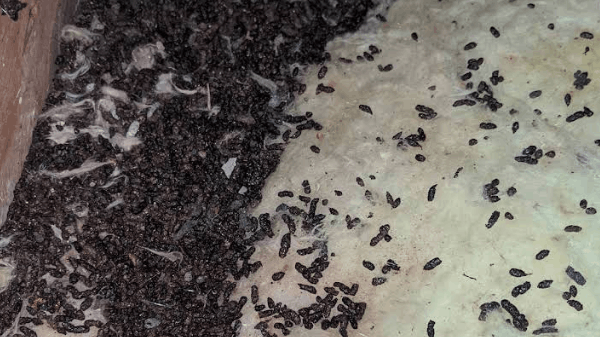
Rice-sized droppings, dark and pointed at the ends, usually clustered in cabinets, drawers, along pantry shelves, or behind appliances.
A faint, musty odor, especially in enclosed cabinets or behind the stove and refrigerator.
Small gnaw marks on cardboard, plastic food packaging, or cabinet corners.
Grease or dirt smudges along baseboards where mice repeatedly travel the same route.
Scratching sounds, usually lighter and higher-pitched than rat activity, most often at night inside walls or above dropped ceilings.
Nesting material — shredded paper, fabric, or insulation balled up in hidden corners.
Pet behavior — a cat or dog fixating on a wall, cabinet, or appliance for no obvious reason.
A single sighting doesn't necessarily mean a large infestation, but given how fast house mice reproduce indoors, it's worth acting on early rather than waiting to see if it happens again.
Why Mouse Problems Escalate Quickly
The core issue with mice isn't their size — it's their reproduction rate. A female house mouse can produce five to ten litters a year, with roughly five to six pups per litter, and those pups reach sexual maturity in as little as six to eight weeks. A single mouse can leave 50 to 75 droppings a day as it moves through a kitchen or pantry.
Because house mice breed year-round once they're inside a heated structure, a "we only saw one" report in October can be an active, multi-generation population by the time spring arrives — which is the single biggest reason DIY trapping without sealing entry points tends to lose ground rather than gain it.
Health Risks: Where Mice Actually Differ From Each Other
House mice, white-footed mice, and deer mice all pose some risk through droppings, urine, and contact with food-prep surfaces, but the specific concerns differ by species — treating "mouse risk" as one generic category misses the more useful, more accurate picture.
House Mice (Mus musculus)
House mice are primarily a contamination concern. Their droppings and urine can carry salmonella and other bacteria capable of contaminating countertops, pantry items, and food-storage areas — the most common practical health issue in an active house mouse infestation.
House mice can also carry lymphocytic choriomeningitis virus (LCMV), a separate concern from hantavirus that's specifically associated with this species rather than with rats or Peromyscus mice.
White-Footed & Deer Mice
White-footed and deer mice are the two species in New York capable of carrying hantavirus — and the two strains aren't interchangeable. White-footed mice carry a strain called New York virus, first identified in this state; deer mice carry a related but distinct strain called Sin Nombre virus.
Human hantavirus cases are genuinely rare in New York, and the large majority of U.S. cases occur west of the Mississippi — this isn't a reason to panic over an ordinary mouse sighting. It is a real, documented reason to handle heavy dropping accumulations in enclosed, poorly ventilated spaces — closed-up sheds, garages, cabins, or storage areas — carefully rather than casually, since the virus can become airborne when dried droppings or nesting material are swept or vacuumed dry.
Important Cleanup Safety Rule: Because of this, the safe approach to any heavy mouse-dropping accumulation is to avoid dry sweeping or vacuuming and have it assessed and cleaned properly rather than handled with a broom.
Property Damage From Mice
Mice, like all rodents, have incisors that grow continuously and have to be worn down through gnawing. In practice, that behavior creates serious physical risks throughout a structure:
Chewed Electrical Wiring
Gnawed wire insulation inside walls, attics, and behind appliances — a documented fire-safety concern for older and modern electrical runs alike.
Damaged Thermal Insulation
Tunneling through fiberglass and cellulose batting causes both loss of R-value thermal effectiveness and provides soft material for nesting.
Food & Storage Boxes
Gnawed cardboard dry-goods packaging, plastic containers, and storage boxes in pantries and basements, leading to immediate food spoilage.
Shredded Nesting Fabrics
Shredded paper, stored clothing, seasonal linens, and upholstered furniture fibers pulled into hidden cavities for brood nest construction.
Concealed Structural Movement: Because mice are small enough to move through wall cavities, above drop ceilings, and behind built-in cabinetry, this damage is often well underway before it's visible from inside a finished room.
Our Mouse Control Process
Inspection
A full inspection covers the kitchen and pantry, basement, attic where accessible, and the exterior foundation and utility penetrations — the places mice most commonly use to get in and nest.
Trapping & Removal
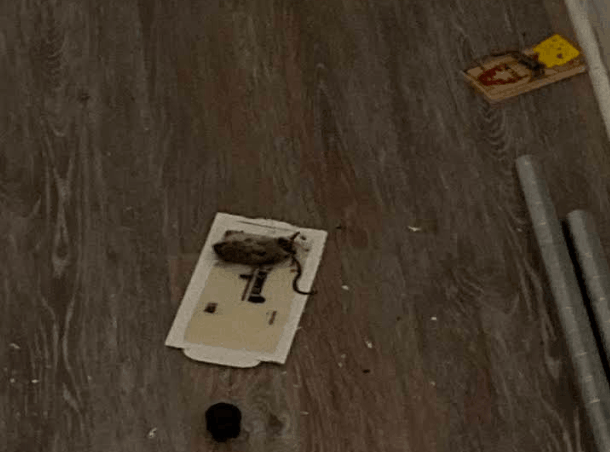
Trap type and placement are based on where activity is actually concentrated — travel routes along baseboards, nesting sites behind appliances, and activity inside wall voids — rather than a blanket approach across the whole house.
Exclusion
Every opening a mouse can use gets sealed: roughly ¼ inch or larger, which in practice means gaps around pipes and utility lines, door sweeps, foundation cracks, and vent openings, closed with materials mice can't chew through.
Sanitation & Follow-Up
For properties with heavy dropping accumulation, we HEPA-vacuum and sanitize rather than leave contaminated material in place. A follow-up check confirms there's no remaining activity, along with practical, property-specific guidance on food storage, clutter reduction, and seasonal timing for re-checking common entry points.
Mouse Activity Patterns Across Albany
Mouse pressure doesn't map onto the same neighborhoods and reasons that drive rat activity.
Pine Hills & Student Housing
Near UAlbany and the College of Saint Rose, mouse activity is tied to inconsistent food storage and high unit turnover, not just building age.
Greenspaces & Park Corridors
Properties backing onto Washington Park, the Pine Bush, or the Normanskill corridor, along with wooded lots in New Scotland, Helderberg, and Buckingham Lake–Crestwood, see white-footed or deer mice moving in seasonally in addition to house mice.
Center Square & Arbor Hill
Older multi-unit and rowhouse blocks see plenty of house mouse activity through settled foundation joints and shared party walls.
Colonie, Menands & Westmere
Because a mouse-sized gap is so small (¼ inch), well-maintained, newer homes aren't exempt the way they sometimes are with rats.
Citywide Hotspots
Kitchens and finished basements are the most common indoor hot spots citywide, regardless of neighborhood, simply because they combine food access with quiet, low-traffic space.
Diagnostic Reference: If you're not sure whether you're dealing with a mouse or a rat problem, droppings size and the entry gap are usually the fastest way to tell — see our rat removal page for what a rat-specific infestation looks like.