

Rodent Control Albany, Ny
Roughly 43% of Albany's homes were built before 1940 — one of the oldest housing stocks in the country. Rubble-stone cellars, shared party walls, coal-chute scars and century-old sill plates give mice and Norway rats a hundred ways in that newer construction simply doesn't have.
We inspect for those specific conditions, remove what's already inside, and seal the building so it stays sealed. Same-day response across Albany and the Capital Region.
Why Albany Has a Rodent Problem That Most Cities Don't
Scratching overhead at 2 a.m. Droppings behind the stove. A chewed corner on a cereal box. In Albany these aren't signs of a dirty house — they're signs of an old one.
Old Buildings That Naturally Leak
About 43% of the city's housing units went up before 1940, with a median build year around 1949. Nationally, only about 13.5% of housing predates 1940 — Albany is more than three times the national figure.
Shared Walls, Basements & Trash
Duplexes, two-families and converted apartments make up roughly 42% of Albany's housing units — ahead of detached single-family homes. Shared cellars, party walls and trash areas mean a mouse problem is rarely one household's problem alone.
Active Neighboring Reservoirs
Roughly one building in thirty sits empty (~1,000 vacant structures concentrated in Arbor Hill, West Hill, and South End). Empty buildings don't stay empty — they become the reservoir that reinfests occupied houses on either side.
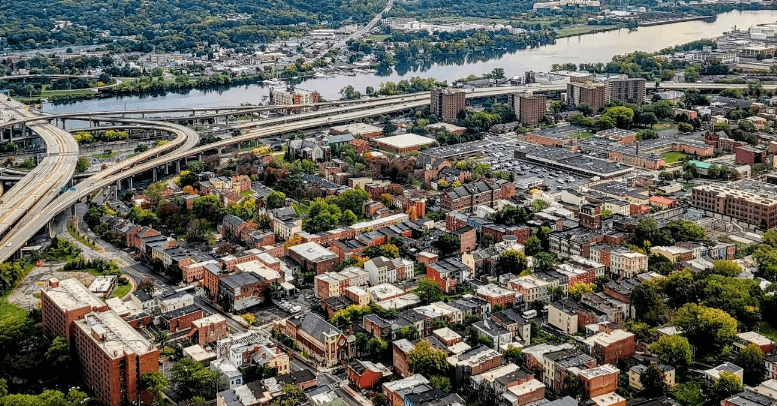
Albany Housing Stock by Era: How Your Build Year Predicts Your Rodent Problem
We can usually guess what we'll find before we open the cellar door, because Albany was built in distinct waves and each wave lets rodents in a different way. Find your era below.
Pre-1850 — Dutch, Federal & Greek Revival
1845–1880 — Italianate & Greek Revival Rowhouses
1880–1930 — Streetcar-Era Frame Two-Families
1940–1969 — Postwar Capes & Ranches
1970–1999 — Apartment Complexes & Subdivisions
2000–Present — Conversions & Infill
What We See, Neighborhood by Neighborhood
Albany's rodent pressure varies street by street. Here is what our technicians see across each neighborhood sector:
Center Square & Hudson/Park
Brownstone and brick rowhouses, many subdivided into one- and two-family units. Party-wall transmission is the defining problem. Cellar-level entry through original coal chutes and areaway drains is common. Lark Street's restaurant density adds a commercial food pressure that pushes rats into adjoining residential blocks.
Mansion Neighborhood & The Pastures
Albany's oldest surviving fabric. Fieldstone foundations, hand-dug cellars, and very little in the way of a moisture barrier. Damp cellars here attract rats before they attract mice.
Arbor Hill & West Hill
Mid-1800s rowhouses alongside a heavy concentration of the city's vacant buildings. An occupied house next to a boarded one is fighting a losing battle without exclusion; we treat the shared wall as the perimeter, not the property line.
South End & Groesbeckville
Architecturally varied 19th-century housing built lot by lot rather than in speculative rows, which means inconsistent foundation construction even within a single block. Proximity to the Port of Albany and the rail corridor adds commercial rat pressure.
Pine Hills & Campus Area
Dense frame two-and-three-families, high rental turnover, and student-cycle trash. The late-August move-in and the May move-out both dump food waste onto the curb outside the normal collection rhythm. Mouse calls here spike two to three weeks after each.
Delaware Avenue & Second Avenue
Early-20th-century frame housing with porches and full cellars. Backyard bird feeders and compost are the two attractants we flag most often here.
New Scotland, Helderberg & Buckingham Lake–Crestwood
Postwar single-family stock backing onto green space. This is white-footed and deer mouse territory more than house mouse territory, which changes the approach: these are seasonal exterior invaders, so the fix is roofline and vent exclusion, not interior baiting.
Normanskill & the Pine Bush Margin
Properties abutting preserved habitat. Expect voles in turf, chipmunks under stoops and slabs, and native mice at the structure edge every October.
North Albany & the Warehouse District
Former industrial buildings converted to residential and commercial use. Large open mechanical spaces, long utility runs, and active nearby construction. Rat territory.
Whitehall & Melrose
A mix of 1920s frame and postwar block. Detached garages and backyard sheds are the usual harborage.
Need an Inspection for Your Albany Property?
Whether you're in an 1850s brownstone in Center Square or a postwar ranch in Crestwood, we inspect the specific era-driven entry points other exterminators overlook.
Albany's Buried Creeks Are Why Rats Turn Up on Quiet Streets
Three streams once ran through what is now the city — the Foxen Kill, the Rutten Kill and the Beaver Kill. All three were covered over and converted into sewers during the 1800s.
Foxen Kill
Historic creek culverted into northern combined sewer trunks.
Rutten Kill
Enclosed 19th-century ravine stream beneath downtown corridors.
Beaver Kill
Drains roughly 5.2 square miles of Albany's geographic heart.
The Beaver Creek sewer now drains roughly 5.2 square miles of Albany's geographic heart. Because Albany's system combines storm water and sanitary sewage, heavy rain overwhelms it and it discharges to the Hudson near the Port — historically around 45 times a year. Almost the entire city runs on combined lines; only the Patroon Creek and Pine Bush areas have separated systems.
That matters for one reason: Norway rats live in and travel through sewer infrastructure, and Albany's is old, combined, and under practically everything. A rat that appears in a Center Square areaway or a Delaware Avenue backyard often didn't come from the block it appeared on. It came up.
Why subsurface inspections matter: This is why we inspect below grade, look at floor drains and abandoned laterals, and ask about basement backups during heavy rain. It's also why collapsing a burrow before a plan is in place is a mistake — disturb an active burrow and the colony relocates somewhere harder to reach, usually further under the structure.
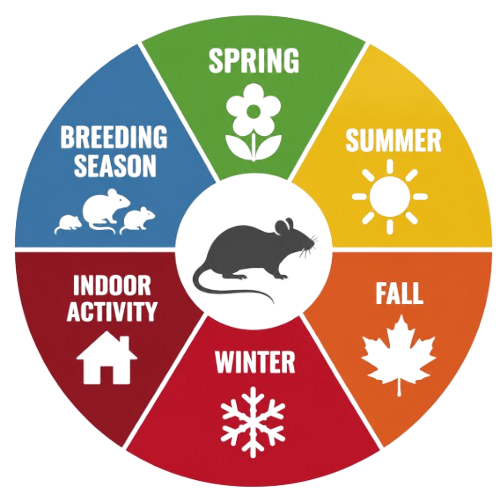
The Albany Rodent Year
Albany's climate does not drift. It drops. Temperatures here typically swing from about 17°F to 83°F across the year, January overnight lows average around 13°F, and more than half of January days never climb above freezing. Rodents respond to that with a schedule you can set a calendar by.
Late September
The First Cold NightsOvernight lows start falling through the 50s. Norway rats begin shifting harborage toward structures. Nothing is inside yet. This is the correct week to do exclusion work.
Mid-October
The First FrostAlbany's first fall frost typically lands in the first half of October. This is the hard trigger. House mice move indoors in volume within days of the first sustained freeze. Most of our residential mouse calls originate from activity that started this week.
Early-to-Mid November
First SnowAlbany's first measurable snow averages around November 16. Ground cover eliminates outdoor food and forces any remaining exterior population into structures. By now you are not preventing an infestation, you are removing one.
December–February
Established IndoorsCold, dry, quiet. Populations are inside wall voids, boiler rooms, attics and cellars, breeding. This is when homeowners first hear them, weeks or months after entry.
March–April
Thaw & ExpansionSnowmelt exposes vole runways across lawns and collapses rat burrows, forcing relocation. Indoor populations that survived winter are now breeding hard. Spring calls are usually bigger problems than fall calls.
May–August
Outdoor AbundanceExterior food is plentiful, so pressure drops. But attic, garage and crawl space populations don't leave. Summer is the cheapest, quietest time to do exclusion properly — and almost nobody does.
Albany's Curbside Rules Are a Rodent Problem Nobody Talks About
The City of Albany collects household trash and recycling from residential properties with four units or fewer. Buildings with five or more arrange their own private hauling — which is why dumpster-adjacent rat pressure is so uneven block to block.
The set-out window is the part that matters: trash goes curbside no earlier than 4:30 p.m. the day before collection, and must be out before 12:01 a.m. on collection day. That means bagged food waste legally sits at the curb through the entire overnight period — exactly when Norway rats forage.
What We Recommend to Albany Clients
Use Rigid Containers, Not Bags
The city permits containers up to 50 gallons with a fitted lid. A lidded can defeats a rat; a plastic bag does not slow one down.
Set Out as Late as Allowed
Closer to midnight than 4:30 p.m. materially reduces overnight feeding hours for urban rat colonies.
Store Cans Out of Public View
This is a city requirement anyway, and moving them off the front walk moves the primary food source away from your building's entry points.
Rinse Containers Before Disposal
Residue in a recycling bin or food packaging provides an immediate scent trail and reliable outdoor nourishment.
Coordinate in Multi-Family Units
In two-to-four-family buildings, coordinate with other tenants. One unit's careless storage habits undo everyone else's prevention work.
Residents are also responsible for keeping their property and adjoining public way clear of litter, debris and overgrowth; the city can clean it and bill the owner, with fines attached. Overgrowth matters more than people realize — dense ground cover against a foundation is exactly the harborage rats look for.
The House Next Door Might Be the Reason You Have Mice
Albany has tracked roughly 1,000 vacant buildings out of about 30,000 properties, heavily concentrated in Arbor Hill, West Hill and the South End.
Many carrying the red X placard mark structural hazards for first responders. A vacant building is a rodent reservoir: no sanitation pressure, no one to notice, no one to call anyone. If you share a party wall or an alley with one, exclusion on your own building is not optional — it's the only thing that will hold.
Report neighbor vacant property activity directly through the city's official SeeClickFix portal for documented code response.
Contact the City of Albany Neighborhood Stabilization Coordinator to verify the structure is on the registry. We'll seal your side regardless, but documented municipal pressure is what shrinks the source.
What's Actually in Albany Homes

Here's the identification detail behind the species list above. Correct identification changes the entire approach — a rat trap won't kill a mouse reliably, a mouse trap won't kill a rat, and an exterior-origin native mouse needs a completely different plan than a house mouse breeding in your wall.
Norway Rat
Rattus norvegicusThe Northeast's city rat. Heavy-bodied, tail shorter than the body, a committed burrower. In Albany they work ground level and below: foundation burrows, cellar entry, sewer infrastructure, and the corridors created by the old buried creek lines. Highest pressure downtown, in the South End, along the Port and rail corridor, near restaurant districts, and around active construction.
House Mouse
Mus musculusThe commensal indoor mouse — lives with people year-round, breeds indoors, doesn't need to go outside. Fits through a gap about the width of a dime. Nests in wall voids, insulation, behind appliances and inside cabinet bases.
White-Footed Mouse & Deer Mouse
Peromyscus leucopus / maniculatusNative field mice, bicolored tails, large eyes and ears. These are exterior invaders, not indoor residents — they come in from wooded edges in autumn and often leave in spring. Expect them in New Scotland, Helderberg, Normanskill, Buckingham Lake, the Pine Bush margin, and in Delmar and Guilderland. Because they arrive from outside on a seasonal schedule, the fix is exclusion at the roofline, vents and foundation — interior baiting alone just resets the clock every October.
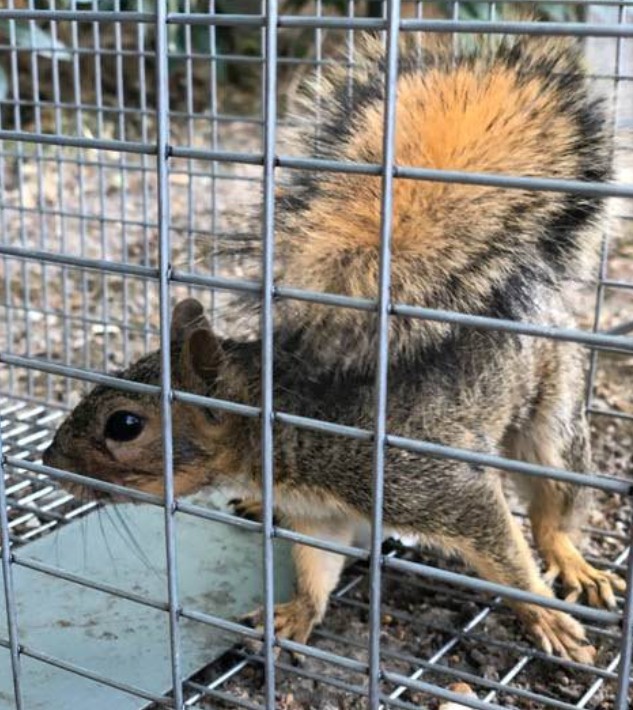
Eastern Gray Squirrel
Sciurus carolinensisAlbany's most common attic invader after the house mouse, and unusual on this list for being active during the day. Squirrels exploit roof edges, soffit returns, chimney caps and roof vents rather than foundation gaps, and will enlarge a small weak point into a fist-sized entry if a nearby tree limb gives them a launch point onto the roofline.
They den twice a year — litters typically arrive in late winter and again in mid-summer — so invasions cluster around those windows rather than the October cold-push that drives mice and rats indoors. Because effective rodenticide isn't labeled or appropriate for squirrels, removal is exclusion-based: a one-way door over the active opening, confirmed vacancy, then a permanent seal.
Meadow Vole & Eastern Chipmunk
Microtus pennsylvanicus / Tamias striatusMeadow Vole (Microtus pennsylvanicus): An outdoor turf pest, not a house invader. Shows up as surface runways through lawns and chewed bark on ornamentals, most visibly right after snowmelt in March.
Eastern Chipmunk (Tamias striatus): Burrows under stoops, slabs, retaining walls and patios. Rarely enters living space, but can undermine hardscape and will use an open crawl space vent.
A Note on Roof Rats (Rattus rattus)
Roof rats are widely listed on pest control websites but are not established in upstate New York — the climate doesn't support them. If a company tells you that you have roof rats in Albany, ask them to show you the specimen. What you almost certainly have is a Norway rat that climbed, or a squirrel.
A Note on Gophers
Pocket gophers do not occur in New York State. If something is tunneling in your Albany lawn, it's a mole, a vole, or a chipmunk.
How to Tell What You're Dealing With
Audio Diagnosis: Listen to Structural Movement
recording is of rodent in albany, ny home
Droppings
Count them, then size them. A single rat produces 40 to 50 droppings a day; a mouse produces 50 to 60. A sudden pile is alarming but doesn't by itself prove a large infestation. What does tell you something: finding large and very small droppings together. That means adults and juveniles, which indicates a breeding population inside the structure — not a lone visitor.
Sebum Marks
Rodents leave an oily brown film along routes they use repeatedly. Look along cellar sill plates, at the base of stair stringers, around pipe penetrations, and on the underside of joists. Heavy sebum means an established, high-traffic run — and it tells us exactly where to place equipment.
Gnaw Marks
Fresh gnawing is pale; older gnawing darkens over time. Check cellar door sweeps, the corners of garage doors, and the edges of porch skirting.
Noise, and Where It Is
Scratching in the wall at a consistent height suggests mice in a stud bay. Heavier movement overhead at dusk or dawn, or thumping, more often means squirrels or raccoons than nocturnal rodents.
Odor
A persistent musty ammonia smell in a cellar or behind a kitchen cabinet usually means an active nest nearby.
Daytime Sightings
Commensal rodents are nocturnal. Seeing one in daylight generally means the population has outgrown the available harborage — or, as noted above, that it's a squirrel rather than a rat or mouse.
Nesting Material
Shredded insulation, paper, cardboard and fabric drawn into a cavity or crawl space.
Safe Cleanup Protocol
Don't dry sweep or vacuum droppings — that aerosolizes particulate. Mist with a disinfectant, let it sit, wear gloves and a fitted mask, bag the material, then bag it again.
Our Albany Rodent Control Process
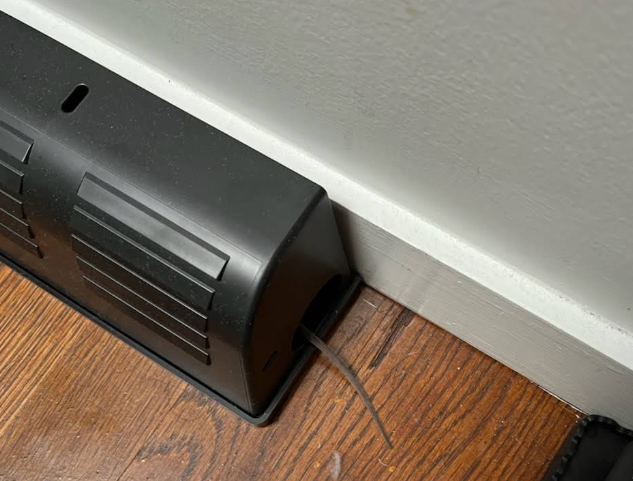
Here's what the services above look like in practice, step by step.
Full-Structure Inspection — Low to High
We inspect from under appliances and behind cellar stairs up through drop ceilings, joist bays and attic knee walls. We're reading entry points, harborage, food and moisture availability, sebum trails, dropping age and size, and species-specific sign. On older Albany buildings we specifically check party walls, abandoned coal chutes, areaway drains, cellar sash, sill plates and the line where an addition meets the original structure.
Non-Toxic UV Fluorescent Monitoring
Where activity is ambiguous, we can deploy non-toxic monitoring blocks — bait containing no rodenticide, but a marker that makes droppings and urine fluoresce under UV. Place them outside, find glowing droppings inside, and you've proven there's an open entry point. Place them in the cellar, find them on the second floor, and you've mapped vertical movement. It's diagnostic work, not guessing, and it's how we avoid unnecessary disruption.
Correct Identification
Norway rat, house mouse, gray squirrel, or native Peromyscus — the answer changes trap type, trap size, placement height, bait selection and whether the plan is interior or exterior. We tell you which species you have and why we think so.
Population Reduction
Trapping is our default. It confirms results, it lets us remove carcasses, and it generates data — species, age class, and sex — that tells us whether we're catching the breeding female or just the wanderers. Consistent male-only captures means we change strategy, often switching from food bait to nesting-material bait like cotton or dental floss.
Rat Neophobia
Rats avoid new objects. We pre-bait unset traps until the colony feeds without hesitation, then set. Rushing this step creates trap-shy rats that are far harder to catch afterwards.
Trap Fatigue
Mice habituate to traps left in one place too long. If captures stop while activity continues, we pull equipment, wait, and redeploy in new positions rather than leaving dead traps in place.
Why we don't use glue boards for rodents: Adult rodents detect unstable surfaces through specialized guard hairs, so glue boards mostly catch juveniles, miss the breeding adults, and leave the infestation intact. They also catch non-target animals and cause prolonged suffering. They have a role in insect monitoring; they don't have one here.
Exclusion — The Part That Actually Ends It
Sealing is the work. Gaps a quarter-inch and larger get closed with materials rodents can't chew: quarter-inch hardware cloth, sheet metal, mortar, or copper mesh backed by sealant. Foam alone is not exclusion.
Repointing with mesh set directly into the mortar, not superficial surface patching.
Fire-stopping stud bays at the sill and at the attic floor level to block continuous chases.
Treating the party wall and shared cellar space as an active part of the exterior perimeter.
Corner settlement cracks, garage door threshold seals, and ground-slab penetrations.
Heavy-duty door sweeps, cellar sash framing, crawl space and gable vents, dryer vents, and every mechanical/utility penetration.
Verification and Monitoring
Droppings are how rodents signal food and routes to each other, so removing them is part of control — and it gives us a clean baseline. New droppings after cleanup means the plan isn't working yet. We keep a written log of captures and sign by location so progress is measurable, not assumed.
Where We Stand on Rodent Poison
We are licensed to use rodenticides and we do use them where they're genuinely the right tool — typically exterior, in locked tamper-resistant stations, in commercial and high-pressure situations. But bait is not our first move in a home, and here's why:
Poisoned rodents die where you can't reach them. Eating bait doesn't send a rodent outside looking for water — that's a persistent myth. They retreat somewhere protected and die there. A mouse in a wall void smells for days; a rat can smell for weeks. Worse, carcasses attract secondary pests: carpet beetles and clothes moths feed on the hair and skin, then move on to your wool rugs and clothing.
Bait fails when there's better food available. If a rodent has access to accessible trash or spilled pantry goods, it won't choose a bait block. Bait without sanitation is money spent on nothing. Furthermore, resistance is real: constant anticoagulant exposure selects for resistant rodent populations, degrading single-tactic baiting programs over time.
Encouraging Natural Predators in the Capital Region
Owls and hawks are genuinely effective rodent predators, and every rodent killed by a raptor is one you didn't pay for. If you want to support them, the single most important thing is not to poison the rodents they eat — a raptor that takes an anticoagulant-dosed rat can die from secondary poisoning.
One honest local caveat: Barn owl nest boxes are widely recommended online, but barn owls are uncommon in the Capital Region and listed as a species of concern in New York State. In Albany, your realistic rodent predators are:
Keep your property poison-free and these native apex hunters will work for you naturally.
Albany Rodent-Proofing Checklist
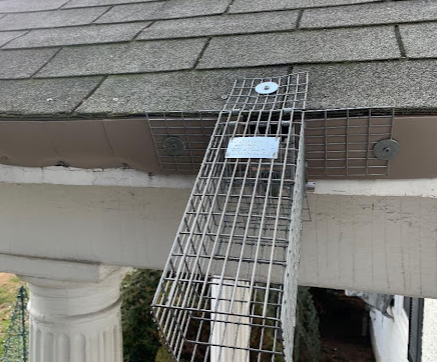
Before First Frost
- Walk the full exterior and mark every gap a quarter-inch or wider.
- Seal utility penetrations: gas, water, electric, cable, AC line sets, dryer vents.
- Install or replace door sweeps on every exterior and garage door.
- Screen crawl space, foundation and gable vents with quarter-inch hardware cloth.
- Repair cellar sash and areaway drain covers.
- Cut vegetation back at least 12–18 inches from the foundation; keep turf short.
- Remove ivy from walls — it functions as a direct ladder to upper windows and soffits.
- Move firewood off the ground and well away from the structure.
- Pull bird feeders down, or accept that they're a rodent feeding station.
Indoor Migration Period
- Switch to rigid lidded trash containers; set out as late as the city rules allow.
- Move pantry staples into hard-sided containers; pet food included.
- Clear cardboard, paper and fabric clutter from cellars, attics and garages.
- Check under and behind the stove and refrigerator for spill accumulation.
Do Year-Round
- Fix plumbing leaks and standing water — rodents need a water source as much as a food source.
- Keep compost as far from the structure as your lot allows.
- In multi-unit buildings, talk to other units. Partial compliance produces partial results.
Our Recent Rodent Control & Removal
 Albany's Trusted Team
Why Homeowners Choose Albany Rodent Control
When a rodent problem appears in your home, you need a team that understands Albany — not a national franchise that sends out a generalist. We are a locally operated rodent control company built specifically for the conditions, housing stock, and seasonal patterns found throughout Albany and the Capital Region.
From the aging stone foundations of Center Square and Mansion District to the wooded suburban properties of Delmar and Guilderland, we've seen every type of rodent situation Albany homes face — and we know how to solve them properly the first time.
We live and work in the Capital Region. We understand seasonal patterns, local housing conditions, and the specific rodent species active in Albany throughout the year.
Rodent problems can't always wait. We offer same-day inspections and emergency rodent services throughout Albany and surrounding communities when needed.
We don't just remove rodents and leave. Every service includes exclusion recommendations and prevention strategies designed to keep rodents from returning to your property.
We inspect foundations, attics, crawl spaces, utility lines, rooflines, and all common entry areas — not just the obvious spots — to identify the full scope of the infestation.
Sealing entry points with the right materials is a specialized skill. Our technicians use professional-grade, rodent-resistant materials to close off gaps that keep infestations recurring.
From single-family homes and apartments to restaurants, warehouses, and multi-unit buildings — we handle rodent infestations of all sizes across Albany and the Capital Region.
We tell you exactly what we find and what treatment is genuinely needed — no upselling unnecessary services. Our goal is your long-term protection, not a repeated service call.
Our team's expertise reflects a commitment to industry-leading safety, professionalism, and effectiveness — giving Albany homeowners and businesses confidence in every service we provide.
We use professional-grade treatment methods designed to protect your family, pets, and property throughout the entire rodent removal and exclusion process.
We serve Albany and surrounding communities including Colonie, Latham, Troy, Schenectady, Delmar, Guilderland, Loudonville, and beyond — fast response across the region.
Frequently Asked Questions
Answers to the most common questions Albany homeowners and businesses ask about rodent control.
What attracts rodents to Albany homes?
Are rodent problems worse during winter in Albany?
How do rodents enter homes?
Can rodents damage electrical wiring?
How quickly do mice reproduce?
Do you offer same-day rodent control in Albany?
Will rodents come back after removal?
What areas of the home do rodents usually infest?
How much does rodent control cost in Albany NY?
Is professional rodent control worth it?
Ready to Solve Your Rodent Problem?
Serving Albany, Colonie, Troy, Schenectady, Delmar, Guilderland, Loudonville & the Capital Region — 7 days a week.
Proudly Serving Albany, Ny
Serving Albany NY & Nearby Communities Albany (Downtown, Pine Hills, Arbor Hill, Colonie, Center Square)