
Why Albany Is Especially Prone to Rats
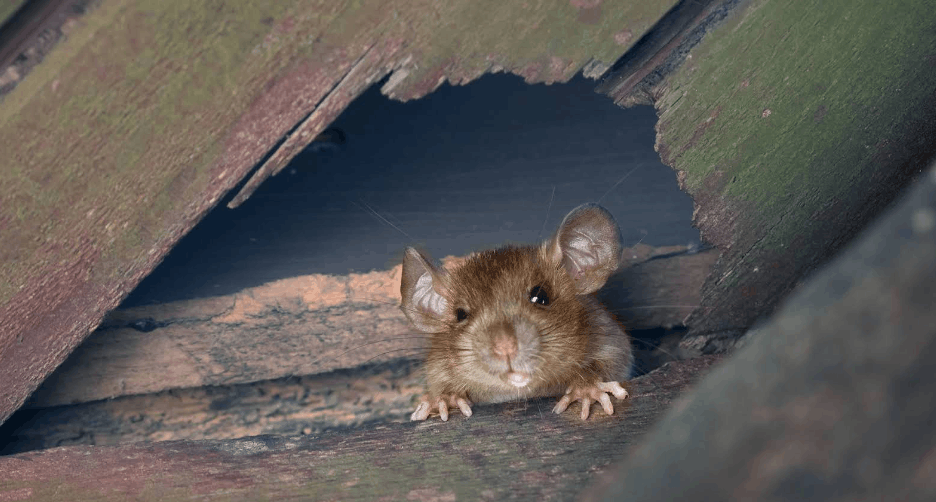
Albany is built on top of its own rat highway.
Three streams — the Foxen Kill, the Rutten Kill, and the Beaver Kill — once ran through what's now the city and were buried and converted into sewer lines during the 1800s. The Beaver Creek sewer alone still drains roughly 5.2 square miles of the city's core, and because Albany runs a combined storm-and-sanitary system across nearly the entire city, that infrastructure floods and backs up during heavy rain.
Norway rats live in and travel through exactly this kind of sewer network. A rat showing up in a Center Square areaway or a South End backyard frequently didn't originate on that block — it came up through a floor drain, a cracked lateral, or a cleanout cap connected to a system that runs under almost the entire city.
The housing stock has a century-plus head start on failing.
Neighborhoods like Center Square, the Mansion District, Arbor Hill, and parts of Pine Hills were built before modern foundation standards existed. Fieldstone and lime-mortar foundations settle and open gaps at the sill plate, around utility penetrations, and along basement window wells — all entry points a Norway rat can use, since they only need an opening about the width of a quarter.
Rowhouses and shared walls turn one problem into a block's problem.
Attached and semi-attached housing in Center Square, Arbor Hill, and the South End lets rats move between units through joined cellars and shared wall cavities. Treating one address in a row without accounting for the neighbors rarely holds.
The waterfront, the rail corridor, and the Port of Albany are established rat travel routes.
Rats move along water and rail the same way people do — following the path, not fighting it. Properties near the Hudson, the Corning Preserve, the rail lines, and the industrial blocks of North Albany and the Warehouse District sit closest to that corridor.
Cold winters set the calendar.
Albany's growing season typically ends with the first hard frost in mid-October. Once temperatures drop, Norway rats move indoors toward heat, insulation, and stored food — which is why fall is consistently the busiest season for rat exterminator calls in Albany, NY.
The takeaway: None of this means every Albany property will get rats. It means a rat control service that actually accounts for this city's sewer lines, foundations, and seasons finds and closes entry points a generic approach misses.
Rat Species in the Capital Region: What You're Actually Dealing With
The rat behind essentially every call we take in Albany. Heavy-bodied, blunt-nosed, brown-to-gray fur, and a committed ground-level burrower. Norway rats dig under foundations, sheds, and retaining walls, enter through floor drains and damaged sewer laterals, and travel established runways along baseboards and foundation walls.
A warm-climate species that dominates the Gulf Coast, the lower East Coast, and the Pacific Coast, and is meaningfully less cold-tolerant than the Norway rat. It is not an established population here.
If a company tells you you have roof rats nesting in an Albany attic, ask for the specimen — what you almost certainly have is a Norway rat that climbed using a downspout or overhanging limb, or a gray squirrel.
Signs You Need a Rat Exterminator in Albany, NY
Rats are cautious and mostly nocturnal, so most homeowners hear or smell a problem before they see one.
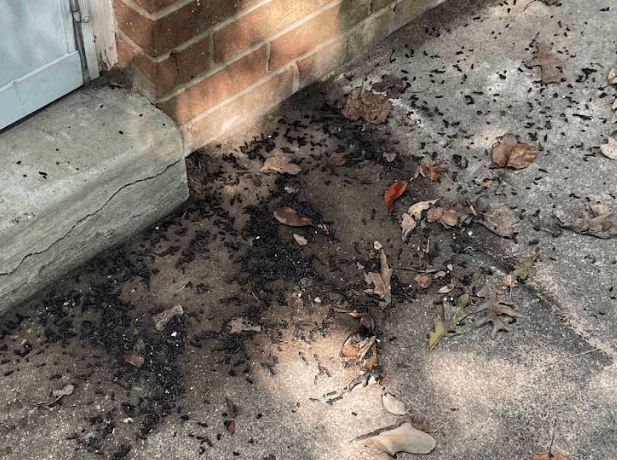
If several of these sound familiar, get a professional inspection before the population grows. A female rat can produce several litters a year, so what looks like a small problem in October can be a much bigger one by January.
Health and Property Risks
Disease Vectors
Rats are a documented source of several conditions people don't always connect to them. Leptospirosis spreads through water or soil contaminated by rat urine — a real concern in Albany basements that flood or stay damp. Rat-bite fever can follow a bite, a scratch, or contact with rat droppings. Salmonella spreads through food-contact surfaces the rats have crossed.
Norway rats specifically are the reservoir host for Seoul virus, a hantavirus strain distinct from the one associated with deer mice — worth knowing, since "hantavirus" gets mentioned constantly in rodent content without anyone specifying which rodent actually carries which strain.
Property Damage & Fire
A rat's incisors never stop growing, so it has to gnaw to keep them worn down — wood trim, PVC pipe, and electrical wiring are all fair game.
In Albany's older housing stock, that's a real fire concern: aging or knob-and-tube wiring behind plaster is more exposed and harder to inspect than wiring in newer construction, and gnawed insulation inside a closed wall cavity is a documented ignition source. Burrowing under sill plates, stoops, and retaining walls can also undermine structures that were already settling before the rats arrived.
Quality of Life
Before there's visible damage, an active rat population usually means disrupted sleep, a persistent odor, and real anxiety about what's moving inside the walls.
That's the reason most people search for rat removal in Albany in the first place — not the abstract health statistics, but the fact that something is audibly living in their house.
Rat Activity by Albany Neighborhood
Rat pressure isn't uniform across the city — it follows the housing stock, the infrastructure, and what's nearby.
Center Square, Mansion District & Downtown
Dense 19th-century rowhouses sitting almost directly on top of the old Foxen Kill and Rutten Kill sewer lines. Tight lot spacing means one building's rat activity spreads to its neighbors quickly, and cellar-level entry through old coal chutes and areaway drains is common.
Arbor Hill & West Hill
Historic rowhouses and brownstones along Clinton Avenue and the Ten Broeck Triangle, aging foundations, and connected basements. Ground-level gaps near sidewalks and alleyways are the usual culprits.
South End & the Port of Albany corridor
Older brick construction close to rail lines and the Port, where commercial freight and food-waste volume add rat pressure on top of aging foundations. This is also the one part of the Capital Region where an occasional roof rat, arriving as freight cargo, is a real (if rare) possibility.
North Albany & the Warehouse District
Former industrial buildings converted for residential and commercial use, with large mechanical spaces and active nearby construction. Digging and demolition displace established colonies, forcing them to relocate into the nearest structures.
Central Avenue, Lark Street & Wolf Road/Western Avenue
Albany's densest restaurant corridors. Concentrated food waste is one of the most reliable rat attractants there is, and pressure here regularly pushes into adjoining residential blocks.
Pine Hills & the Campus Area
Dense older two- and three-family homes near the UAlbany and College of Saint Rose corridor, with shared walls, aging foundation joints, and heavy rental turnover. Trash left out on non-standard schedules around move-in/out weeks reliably drives short-term spikes.
Washington Park edge & Delaware Avenue
Mature trees and dense landscaping give rats outdoor cover close to basements, especially once temperatures drop in the fall.
Menands & Colonie
More suburban lot layouts, but properties backing onto commercial corridors, dumpsters, or drainage areas still see regular Norway rat pressure.
Westmere & the Guilderland edge
Newer construction generally means fewer foundation gaps, but sheds, decks, and mulched beds still attract ground burrowing activity.
Seasonal Rat Activity in the Capital Region
Rat pressure in Albany isn't constant — it follows a pattern tied directly to the region's climate.
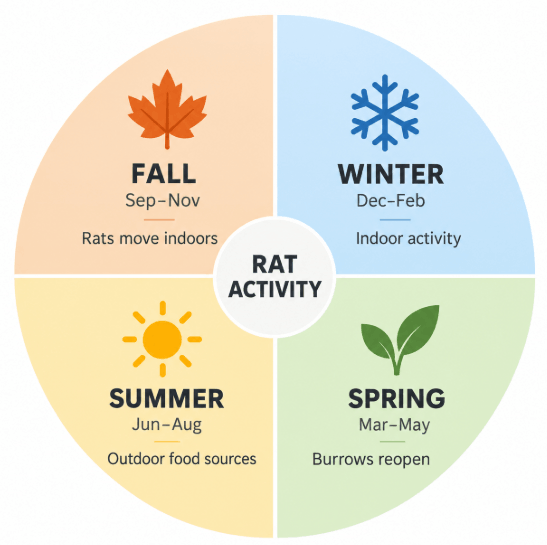
The busiest season for rat control service calls in Albany. As nights cool toward the city's typical mid-October first frost, Norway rats move out of yards, woodpiles, and sewer lines and into basements and crawl spaces looking for warmth.
Activity continues indoors, concentrated in basements, boiler rooms, garages, and wall voids near heat sources — the only parts of a structure that stay warm through an Albany winter.
Snowmelt exposes outdoor burrows near foundations and sheds again, and rats that overwintered indoors start pushing back out to breed. This is also when active construction and utility work — common downtown and along the waterfront once frost is out of the ground — tends to displace established colonies into the nearest occupied structure.
Outdoor food sources (gardens, compost, unsecured trash, spilled birdseed) pull activity outdoors, but cluttered garages and accessible dumpsters still draw rats toward buildings. This is also the cheapest, easiest season to do exclusion work, precisely because nobody's doing it under pressure.
Proactive Prevention Insight: A lot of Albany homeowners treat rats as a winter-only problem and let their guard down in summer. Sealing entry points before fall arrives is the single most effective thing a homeowner can do to avoid the October rush.
Our Rat Control Process in Albany, NY
A rat problem doesn't get solved by traps alone. Removing the rats currently inside and stopping new ones from getting in are two different jobs — skip either one and the problem comes back. Here's how a complete rat pest control service in Albany, NY should work:
Inspection & Assessment
A full inspection covers the exterior foundation perimeter, basement or crawl space, attic where accessible, and any interior area showing activity. On older Albany buildings we specifically check party walls, coal chutes, areaway drains, floor drains, and cellar sash — the entry points this city's housing stock actually has.
Targeted Trapping & Removal
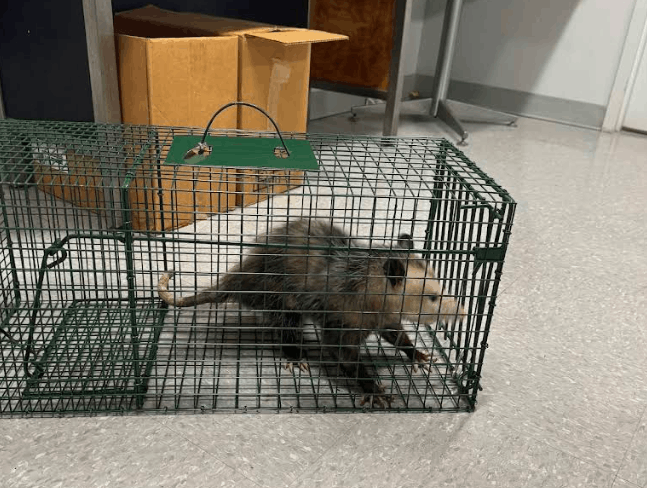
Trap placement follows observed rat travel — rub marks, droppings, gnaw damage — not guesswork. Because Norway rats are neophobic, we pre-stage unset traps until the colony feeds without hesitation, then set them; rushing this step just creates trap-shy rats that are harder to catch later.
Depending on severity, this can mean snap traps, multi-catch stations, and, where appropriate, tamper-resistant bait stations placed per EPA label requirements and DEC regulations.
Exclusion — Sealing Entry Points
This is the step that actually ends recurring rat problems. A Norway rat can squeeze through an opening about the width of a quarter, so every gap that size or larger gets sealed with material rats can't chew through: galvanized steel mesh, sheet metal, mortar, and rodent-rated sealants, plus door sweeps and vent screens where needed.
Sanitation Guidance & Follow-Up
We give property-specific guidance — where firewood or debris is creating cover, where trash storage needs to change, where grading or gutters are directing water (and rats) toward the foundation. A follow-up visit confirms traps are clear, seals are holding, and there's no renewed activity.
Licensed, Insured & DEC-Certified
Pesticide use for rat control in New York is regulated, and it's worth knowing what to check for before hiring anyone for rat removal in Albany.
DEC Business Registration
Any company applying pesticides for hire in New York must be registered with the NYS Department of Environmental Conservation under 6 NYCRR Part 325.
Certified Applicator, Cat 7A
Structural and rodent control in NY falls under DEC Applicator Category 7A (Structural & Rodent Control). Applicators pass core and 7A exams with 3-year recertification.
EPA-Labeled On-Label Use
Governed by federal EPA labels and state rules. Tamper-resistant bait stations and placement limits exist specifically to protect children, pets, and non-target wildlife.
General Liability Insurance
Comprehensive policy coverage that protects your residential or commercial property in the rare event of accidental damage during inspection or structural exclusion.
Public Verification: You can verify any New York pesticide business's registration status directly through the DEC's NYSPAD (New York State Pesticide Administration Database) portal before hiring anyone for rat control in Albany, NY.